Flow is a new creative exploration, telling the story of a river through the power of sound.
Past, present, and future flow together as artists transform field recordings, research and satellite images into a recomposed interpretation of the life of a river. The river’s story, reimagined in sound.
The project is a collaboration between the University of Padova and the University of Würzburg, with support from Cities And Memory
The river stands at the centre of contrasting visions. For some, it is a resource to be harnessed; for others, a living landscape to restore and protect.
Yet the river shapes all of our lives. It lies at the forefront of the climate struggle, capable of both safeguarding our communities or challenging them. So what should our relationship with rivers look, feel and sound like?
In Flow, artists reflect on climate change, the environment and what rivers mean in their lives, using sound as the medium.
The project will be presented at the EGU (European Geosciences Union) general assembly in Vienna in 2026, the most important geoscience conference in Europe.
Special thanks to Riccardo Fumagalli and Martina Cecchetto for help, support and inspiration!
A Data Sonification of the Lech River
The River as Score
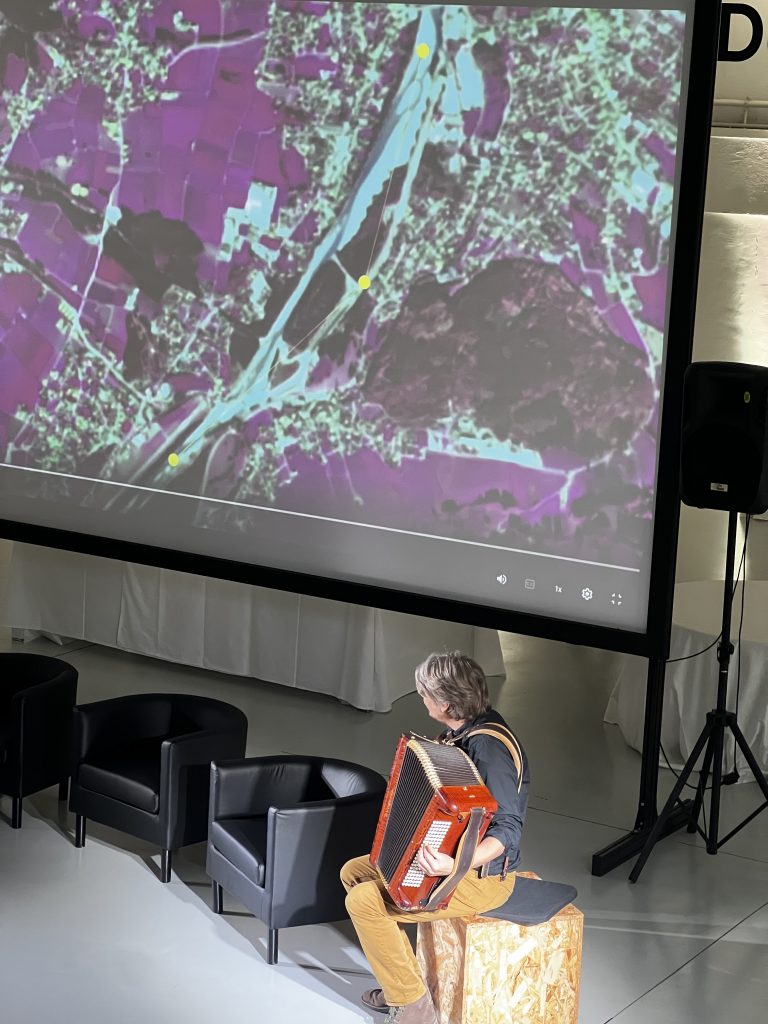
A river does not compose. It erodes, carries, deposits. Over centuries it traces a shape into the land — a shape that is the accumulated record of rainfall, geology, seasonal flood, and human intervention. This project begins with a simple question: what does that shape sound like?Using computer vision applied to satellite imagery, I extracted the geometry of a segment of the Lech river. From this geometry I simulated 300 trajectories — triplets of coordinates describing the paths that small stones might travel as they roll along the water flow. Each triplet becomes a pair of pitches, derived from comparing the point’s position within the river’s width and the segment’s length to a given musical scale. The data does not illustrate the river. It becomes the river’s voice — oblique, distributed, never quite repeating.
Listening Like a River Bank
The musical material is deliberately modest: long tones, broken arpeggios, pizzicatos. These are not interpretations of the data — they are its shadows. Harmonies emerge not from compositional intention but from the spatial distribution of 300 points across a riverbed. Some small musical forms surface briefly and dissolve, the way a eddy forms in shallow water and is gone before you have named it.The experience this work invites is close to a particular kind of attention — the attention of someone sitting on a bank, watching water. Not analyzing. Not judging. Allowing the mind to follow the surface until the distinction between observer and observed quietly loosens. Patterns appear. Whether they are in the data or in us is precisely the question the piece does not answer.There is a specific joy available in this kind of surrender — in relinquishing the expectation that music should go somewhere, and discovering instead the pleasure of aleatory variety, of randomness that is not arbitrary because it carries the memory of a physical place.

History Flows with the River
The Lech is not only a natural form. It is a historical one. Its current shape reflects centuries of channeling, dredging, and management — the marks of communities that depended on it, altered it, lived beside it. The random paths of the simulated stones are therefore already entangled with human time.Late in the piece, this entanglement becomes explicit. The voice of a local Lorelei appears — drawn from Andrea Zanzotto’s poem Femene che le lava, written in Venetian dialect. The poem recalls the women of his village descending to the river to wash clothes: an image so old it barely needs explaining.. Zanzotto’s images — rooted in the Venetian foothills, in the sounds of a community already disappearing when he wrote — arrives as sediment does: carried from upstream, deposited gently, changing the texture of the riverbed.The voice does not resolve the piece. It passes through it, as the women passed through, as everything passes through.

Technical Note
Satellite imagery of the Lech river was processed using computer vision techniques to isolate the river’s outline and identify its navigable segment. 300 coordinate triplets were then simulated within this area to model plausible stone trajectories along the water flow. Each point was mapped to two pitches by relating its X/Y coordinates to the river’s local width and total segment length, using a fixed musical scale as the conversion frame. The resulting pitch sequences form the harmonic and melodic raw material of the composition, realized through sustained tones, arpeggiated figures, and pizzicato textures.
